

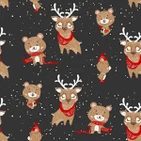
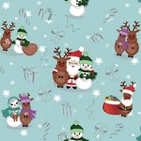
Printing fabrics is the process of using dyes or paints to form patterns on already woven fabrics. Printing belongs to partial dyeing and has high requirements for the color fastness of dyes or paints.
The printing process is divided into reactive printing and general printing.
Reactive printing, as the name implies, means that our printing dyes are processed by reactive printing and dyeing. The design elements of reactive printing are more diverse: plants, flowers, geometric figures, English letters, and different color blocks are organically combined, and different design styles are expressed through design techniques. Such fabrics are suitable for a wide range of groups and are applicable for a long time.
Reactive printed fabrics are bright in color, good in colorfastness, soft to the touch, can be washed often without fading, and look like new for a long time.
Advantages: bright colors, good hand feel, soft and comfortable, high colorfastness to washing, more environmentally friendly and safer;
Disadvantages: high cost, floating color, avoid washing with light-colored cotton clothes.
Pigment printing is one of the technological methods of fabric printing. Coatings, unlike dyes, are not direct to fibers. Can not be combined with fiber, it is just an insoluble colored powder, mostly organic compounds, but also inorganic. The principle of its "coloring" on the fibers is that it is fixed on the surface of the fibers with the help of a synthetic resin that can generate a strong film, so it can be printed on fabrics of various fibers.
How to distinguish between pigment printing and dye printing?
Pigment printing and dye printing can be distinguished by comparing the difference in hardness between printed and unprinted parts of the same fabric. The paint-printed area feels a little harder and maybe a little thicker than the unprinted area. If the fabric is dye-printed, there is no noticeable difference in hardness between the printed and unprinted parts.
Advantages: low cost;
Disadvantages: The fabric is dull, feels hard, and fades easily.
Embroidered fabric is a kind of fabric material. The material on it is pure cotton, lace, etc., but it is embroidered with many beautiful patterns. Traditional fabrics are produced without any color and need to be dyed.
The embroidered fabric is to add the computer embroidery flower pattern after dyeing and processing. The fabrics produced in this way are several times more valuable than traditional fabrics.
And because of the wide variety of embroidery, it can embroider a variety of beautiful patterns, which is favored by consumers. Therefore, this material is called embroidered fabric.
Two embroidery techniques are described below.
Color embroidery generally refers to the embroidery technique of making patterns with various colored embroidery threads. Its bright colors are widely used in bedding and clothing.
Colorful embroidery has rich color changes, and different color effects are produced by overlapping, juxtaposing, and interlacing various colored embroidery threads.
Appliqué embroidery is also called applique embroidery, and the appliqué embroidery in Suzhou embroidery also belongs to this category. Cut the patch according to the requirements of the pattern and stick it on the embroidered surface. Cotton can also be lined between the patch and the embroidered surface to make the pattern bulge and have a three-dimensional effect. After pasting, use various stitches to lock the edges, the embroidery method is simple and the style is unique.
Advantages: good color fastness, not easy to fade in washing, good air permeability, and moisture absorption.
The pattern on the jacquard fabric is woven using a certain manufacturing method, rather than printing, which is more different from embroidery. Different changes of warp and weft threads are used in fabric weaving to form different patterns. This weaving method requires fine yarns, extremely high requirements for raw materials, and a high density of needles and threads. The fabric is not easily deformed and will not fade during use. more comfortable.
The jacquard process is quite different from the previous two. Both printing and embroidery are printed or embroidered on the basis of the woven fabric, while the jacquard is arranged in an organized manner to form patterns during weaving.
At present, jacquard is very popular in the market, it appears high-grade, tasteful, and the relative cost is also higher.
Advantages: fine yarn count, high needle thread density, no deformation, no fading, and good comfort;
Disadvantage: high cost.